Monday, November 30, 2015

Fave New Music: Oct / Nov

Time for another music post!  \(۶•̀ᴗ•́)۶/ I combined months since I didn't find much music in October, but November has been great for finding new writing music! I'm always super grateful for the playlists Spotify puts together. A good number of these are from indie playlists!


Because this post is really long and video-heavy, I'm putting it under a read-more cut. I'm hoping to have a YouTube playlist up within the next few days that'll streamline this post! I've been meaning to do that for the past couple Fave New Music posts but I never get around to it (;° ロ°)

The formatting of the videos isn't uniform, so I apologize in advance! I just figured out that embedding the videos from the HTML YouTube provides is better than trying to embed them from within Blogger, so I'll keep that in mind for next time!

Friday, November 27, 2015

Waterfell by Amalie Howard

TL;DR Talented but with aquatic aliens
(finished 10/30/15)
TBR #465

I really did not enjoy Waterfell. It was one of those books I only finished so I felt like I could write a comprehensive review about how much it frustrated me. (I really need to stop doing this and just let myself write DNF reviews.)

Although I will be honest, part of the reason I read to the end was to see how the climax and the ending would be handled. There were moments fairly early on that screamed "foreshadowing", and I wanted to see if I was wrong or not.

I was not wrong. None of the supposed plot twists were surprising. At all. I saw the whole thing about Lo and Ehmora coming since Lo was introduced. I was way more on the mark than I was expecting to be, and for it to be ~so surprising and earth-shattering~ is really unbelievable. I have to admit, I didn't really predict the thing regarding Nerissa's mom, but it wasn't surprising. I was just like, "Yep. Sounds about right."

And along the same line, I really did not enjoy any of the characters. Not even Jenna. Nobody had any depth. Everyone was characterized inconsistently and nobody sounded human. Even Jenna. This wasn't even a "these teenagers sound like an adult woman" -- their dialogue sounded kind of stilted / scripted too much and not like anything someone would say naturally.

Nerissa acted like she was the all-powerful heir she supposedly was while still behaving like the spoiled brat she swore she wasn't anymore. She totally blew off all her Aquarathi responsibilities for the longest time and then just ~suddenly and maturely~ decides to step up and take her throne back. And then goes about it in a really stupid way.

I think Nerissa could have potentially been done really well in terms of responsibility vs teenage behavior, but she was polarized a little too much. She went from one end to the other without having a believable transition. (I guess this could be written off by her being an alien, but I don't know. That feels kind of weak.)

Nerissa and Lo acted so bipolar with each other and I honestly cannot understand where their mutual attraction came from. Even with the explanation the story gives by the end of the book, there's no proof of it. It just magically occurs without appearing in the narration. Nerissa and Lo's "romance" was so instantaneous and without any sort of foundation, I think it actually beats out the Soul Seekers series in ridiculousness. Romances can't just come out of nowhere, you know? Instalove isn't actually a thing in real life. Insta-lust maybe, but even then the relationship still has to build up somehow. You can't just immediately jump from enemy-ish behavior to boyfriend-girlfriend behavior within the span of a few pages.

The narration was probably the most frustrating thing. It's written in 1st person present from Nerissa's perspective, but she's unnecessarily flowery and detailed with her descriptions. The two don't work together. I could've excused it if it were in past tense, but giving so much detail in present tense just isn't possible without giving up suspension of disbelief. The amount of detail throws off how time seems to pass from a reader's perspective.

On top of that, there were huge gaps in the narration. The transitions between chapters would skip fairly important goings-on and then just explain them in an info-dump. There were also a bunch of times that Nerissa spent a ridiculous part of the narrative explaining things that are easy to assume as a reader. We're not idiots. We can figure out people's moods based on what they're saying and doing. We don't need that spelled out.

The only reason I managed to trudge through the last half of the book is because of Ariana Grande's "Focus", which coincidentally came out the day I finished it. (I find the title of it very ironic. But hey, it helped.) I was having so much trouble reading more than three paragraphs at a time before finding "Focus" that I was very tempted to DNF.

The Aquarathi were fairly interesting in concept, but they fell flat quickly. I don't understand how they got from Sana to Earth, and it really bothers me that it's never touched on. (Like, can they survive in space? Did they build a spaceship? Did they just magically teleport?) Nerissa's narration also gave differing answers to when they arrived on Earth, and I'm not sure I marked any quotes to back it up, but at one point she implies they've been on Earth for a long time and later implies it's only been a few centuries.

Also, I have no idea what the heck they're supposed to look like. They have legs and a tail? They have underbellies? The "heir" has a crown growing out of their forehead? I get that they're aliens and all, but there's no solid explanation of what they look like or how their biology really works. Not to mention that, but they're extremely overpowered. There's mentions of swimming from the Mariana Trench to San Diego like it's walking down the block, even though that's across the Pacific Ocean. Nerissa's emotions control the weather and she can control the water in other people's bodies, look into their memories, and somehow convinced the Aquarathi to back her up while giving them nothing to trust her with. I mean, she's not as bad as Talented's Talia was, but she's pretty damn close.

TL;DR the main characters were overpowered and wishy-washy, the narration style didn't fit the story, and the plot was too predictable. I don't recommend it.

Tuesday, November 24, 2015

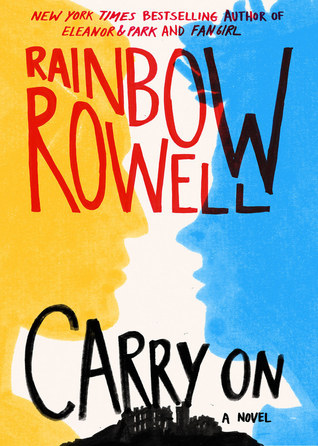
Carry On by Rainbow Rowell

TL;DR Harry Potter-ish but aimed towards a fangirl audience (heh)
(finished 10/27/15)
TBR #1193

From my review of Fangirl from back in May 2014: 
Also, it was really cool to have excerpts from the Simon Snow series and Cath's fanfictions. I would probably read the Simon Snow series, to be honest;; 

Let me tell you I just about screamed when I saw Rainbow Rowell's tweet about making Carry On its own book. I really enjoyed Fangirl, so I was really excited to see that I had a chance to get more of a taste of the Simon Snow universe. 

The first thing I have to say is that Carry On is not Cath's fanfiction (which is called Carry On, Simon). I initially assumed it was supposed to be, but the author's note at the end states that it's Rainbow Rowell's own take on the Simon Snow universe instead of in relation to Cath or its author in Fangirl. I find it really interesting, but it probably would've been good to know going into the book. 

(That's actually totally my fault since I went into it assuming it was Cath's fanfiction even though there's no mention of Fangirl in the blurb.) 

Carry On actually does resemble a well-written fanfiction. It's not glaring, but the voice is unique and it really does read like something not written by an adult woman. (Although honestly, I don't know the age / gender of the authors of a lot of fanfics I read, so this could be a wrong assumption.) There was no obvious bleed-through of the author; all the narrators had distinct and well-matched narration styles. It felt a lot like fanfictions for children's series where the author is like "my audience is older so I can pretty much do whatever I want" and includes a lot of content that wouldn't have made it into the original series.  

The chapters have different narrators, but it's fairly biased towards Simon -- which is understandable, since he's the main character. I liked how using narrations from (almost?) all the main characters built up the story in a puzzle-piece kind of way and allowed for exploring stuff not directly related to Simon. The chapters were labeled with their narrators, and even without that it was fairly easy to figure out who the narrator was. (They're not all distinct from each other -- meaning you can't tell who exactly it is from one sentence / paragraph -- but they had different styles that effectively contrasted against the other characters and could narrow it down if you picked it up in the middle of a chapter.) 

The world-building was super cool. There were a lot of things that I hadn't actually considered in terms of magic that played a key part -- I haven't seen anything like their system of magic before. (That doesn't mean it doesn't exist in other books, but I haven't found it.) I really liked that the spells were printed in bold; spells are "words laced with magic" (if I remember correctly) so it was a really cool way to convey that they felt different from normal words without having to prove it in the narration. 

I'm also really happy with the representation of the main characters, both in terms of ethnicity and sexuality. I'm also really happy that Carry On's main romance is LGBT+ but it doesn't seem to be marketed that way. (Meaning that books portraying same-sex romances are usually focused on the romance and the problems that arise. That's not bad, but I like that the romance is normalized / that the fact that it's same-sex doesn't create a huge problem in the plot.) 

The plot wasn't what I was initially expecting, but I was impressed by what ended up happening. To me, it didn't really feel like it followed a plot diagram (the ones that look like stock market line graphs), and that made it feel more realistic. It resembled the randomness of things happening in real life. Of course, the way everything tied together so nicely didn't, but it's a standalone. There's only so much you can do with that and still have a good ending. 

The ending was fairly surprising for me in terms of the futures of all the main characters. I would actually like to see more of all of them in their lives after Carry On, but the ending wraps the story up nicely to the point that trying to create a sequel might be messy. ("You either die a hero or live long enough to become a villain" sort of thing -- like how successful series tend to get unnecessarily drawn out just because they make money. I've seen this argument a lot regarding the ending of Gravity Falls, but I think it applies to books just as nicely.) 

Like I did with The Sword of Summer, I'm going to hold off on adding quotes into my review until the book has been out a little bit longer. Most of the stuff I've sticky-noted is a little spoiler-ish. 

TL;DR I loved Carry On as a "real" novel that resembled some of the fanfictions I've really enjoyed and I'm so happy that this book (and Fangirl) exist.

I feel like I'm fairly biased, so if you want another perspective, The Quiet People's review raises a lot of good points. (I really like The Quiet People's blog tbh)

Saturday, November 21, 2015

Shadows by Robin McKinley

TL;DR getting rid of witchcraft doesn't go as planned
(finished 10/24/15)
not on TBR

Shadows was one of the very rare books I pick up from the library that isn't on my TBR. I almost didn't read it because it sat at the bottom of my book stack, but I'm glad I decided to after all.

The first thing I really noticed was the voice of Maggie. She sounded unique and effectively used run-on sentences to be interesting rather than appearing like a lack of grammar skills. It could definitely come off as annoying, but I liked it.

The worldbuilding could have been stronger, but I think it's believable considering what we learn about Maggie and the world itself. There's not too much room to develop the magic when it's in first person and Maggie lives in a kind of world that's tried to erase magic. Maybe there could've been a way to integrate more worldbuilding, but I think it functions.

I'm very intrigued by the laws of the universe in Shadows. I would actually love to know more about it. I'm actually a little sad that it's not explored more (since Goodreads tells me Shadows is a standalone). The ending was a little disappointing in that it was super open-ended and left a whole bunch of room for more plot but it's just like "oh. We're done. Use your imagination, I guess."

Maybe it is part of a larger series and I'm just unaware. I don't know. I've never read any of Robin McKinley's books before. Which is also apparently why I'm in the minority on this book -- the negative reviews seemed disappointed because of the bar her other books set.

The dustjacket blurb was pretty useless. Caz didn't have nearly as much of a part in the plot as the blurb made it out to be, and Val, Takahiro, and Jill had a lot more presence than I expected.

I liked all the characters. They weren't too developed, but they felt human within the scope of the story. I also got surprisingly attached to them. Mainly Takahiro. I think also the problem with the human-ness was that the story is supposedly a standalone, so there was a lot of stuff going on that had to be covered, and the plot took more precedence than making the characters feel like they could jump right out of the book.

(I have determined my basis for "human-ness" or realistic-ness of characters is if I can come up with headcanons for them outside of the story. So, for Shadows, I can't, but I still liked the characters nonetheless.)

(I'm also pretty sure I make no sense with saying they don't feel developed but yet I love them anyway. I don't know. Take it at face value?)

The only things I sticky-noted were these two pieces of dialogue and a surprising spoiler that I left off for the sake of preserving said spoiler. Which is also why I redacted some of the second quote. (The first two little paragraph sections below go together.)
"[...] Usually the Mammothmobile is stuck to the side of your house by several months' worth of cobwebs because nobody wants to pay for the gas." [Maggie]
"Nah," said Jill. "Greg takes it out at least once a month and runs over any small annoying children that have piled up in our neighborhood since the last time he took it out. [...]" (pg 252 - 253)
"I didn't have a clue," Jill said, "but Caz figured it out instantly and was like whipping his socks off and I'm all whoa, I'm fine for skinny-dipping but where's the lake, but then [spoiler] and I finally got it." (pg 342) 
(That last quote. I just about died. Jill is my fave.)

Adding onto the blurb uselessness, I had no idea that the plot would take the direction it would. I mean, it's good in that it didn't reveal any important information past the exposition / inciting incident, but I was still vaguely "??" for a good part of the plot. Maybe a lot of that was my inability to guess where the story would go. Which can be a very good thing. It didn't frustrate me at all, which is good. It kept me intrigued.

Like I said earlier, I wasn't too happy with the end, but that was mainly because I felt like I was being cheated out of a lot of good subsequent adventures. I would love to see the continuation. (I just want to see more of the characters, honestly. Despite saying they weren't the most human I still got really attached to them.)

TL;DR I really liked Shadows for its characters and its world but I haven't read any of the other books by the same author so I can't say if it's on par for the author or not.

Wednesday, November 18, 2015

The White Aura by Felicia Tatum

TL;DR soul mates and plot holes
(finished 10/19/15)
free through Bookbub

I read the first part of The White Aura over a period time since I had it on my iPod and really only touched it while trying to wind down for bed, so I don't feel like I can comment too well on that.

At some point, though, I sat down and marathoned The White Aura so I could be done with it, so I will be talking very heavily about that part. 

My notes mention that I was okay up until about 1/5 in, where it suddenly turned melodramatic and trope-ish. (From what I remember, the second chapter was entirely cliche, but I think I forgave it at that point.) 

The narration was basic. There were a lot of the same sentence structures, what's-her-face and Scott's narrations sounded almost identical, and a terrible balance of what needed to be said vs. what was actually said. The only real difference in the narrations was Scott being overly possessive of a girl that didn't even know him yet and sounding way too much like a bad fanfiction version of Edward. And what's-her-face regaled way too much detail about her morning routine and what she decided to wear and spent a significantly less amount during pretty important plot moments. 

(I have forgotten the female main character's name. I think it's Olivia. I wrote the first half of this review pretty close to finishing the book and I still couldn't remember it. That's not promising.) 

And honestly, what's-her-face and Scott came off as very Twilight-trope. It's been a long time since I've actually read the books, so I know my memory of them has been distorted by time and the media, but Scott was extremely reminiscent of creep-Edward. Especially with the whole thing that he was meeting what's-her-face in her dreams for over a year before they moved past the whole makeout session thing and actually talked. Like, you know, don't you want to actually converse with your "heartmate", and not just stick your tongue down her throat and your hands up her shirt? No? Apparently not.

The plot didn't feel consistent to me. There were also some flaws of reasoning that I don't know if they weren't thought out completely or if they were just swept under the rug for the sake of the plot. Like, this curse is supposed to go into effect when they meet, but haven't they still been meeting each other in dreams this whole time? That in itself should negate the purpose of this entire book. What's-her-face is already doomed. People and their heartmates are supposed to be super-intwined with each other and yet there's no indication whatsoever of Anna's heartmate. Scott's so inflicted by being apart from what's-her-face and yet Anna goes the entire book without even just a passing mention of who she's married to? That doesn't seem right. 

The whole "problem" of the story felt kind of insignificant to me. The reasoning behind the curse was never explained (or if it was, it wasn't strong enough to make me remember it) and the villain made no sense. He was definitely one of those "evil to be a plot device" character. He didn't have any goals of his own other than to apparently kill Scott and what's-her-face. 

Also, at the climax the characters manage to forget the initial problem in its entirety until the last paragraph. It creates an unnecessary cliff hanger and brings the book to a crossroads: either The White Aura was entirely for nothing, or the entire problem is going to be written around and given a plot shield so that both the characters survive. That in itself killed any small desire I had to continue reading. (Considering it's at least a trilogy, I'm 99% sure the problem is just written around.)

Juniper, Scott's sister, and Anna all felt like means to an end, too. They didn't have goals of their own. They only existed to support Scott and what's-her-face. Juniper got the complete "best friend syndrome" treatment: [highlight for spoiler] she got killed for just about no reason other than emotional shock factor and then is brought back to life through ~witchcraft~, which completely negates the negligent effect her death had in the first place. I liked Scott's sister to an extent but she felt very trope-ish and kind of overpowered. 

The biggest positive I can come up with is that there were almost no grammatical errors. That was definitely a plus. There were a few minor problems with "dialogue" tag / action "dialogue" lines, but they were easy enough to forgive. 

TL;DR it had a good idea but I wasn't sold on the characters or the execution at all. If I ever encounter a re-write, I'd probably read it, but I doubt there's going to be one based on the subsequent books being established / most likely published (I don't remember if they were).

In my research into The White Aura, I found Hardly's review on Goodreads, which I feel is much more succinct than I am and covers the part of the book I didn't talk about because I forgot a lot of the details about it.